Andrada Family Sawmill
Gente que viene y ¡Bah!The Andrada Family Sawmill is a timber-processing business on the outskirts of San Esteban whose reach extends beyond the lumber it sells: its forest purchases and logging operations feed into the town’s wider biomass development. As a sawmill, it sorts timber for boards and directs other purchased wood toward biomass; as a conspicuous industrial site beside an expanding energy complex, it becomes a focal point for arguments about jobs, forest use, property rights, and environmental cost.
Location and Industrial Setting
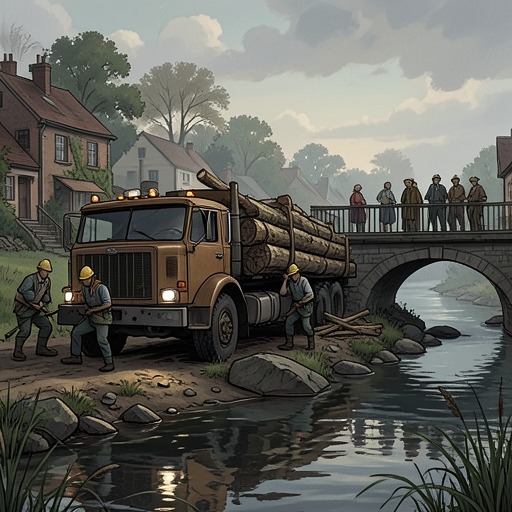
The sawmill stands outside the town, amid a broad yard where hundreds of logs are stacked and a large chipper reduces wood to chips. Pine and eucalyptus are especially abundant among the timber. Bea, who has a longstanding interest in wood and its uses, sees the yard through both a designer’s and a customer’s eyes: the scale of the piles impresses her, while the varieties of wood make a visit there feel like an attraction in its own right. The setting is not simply a lumber yard, however. By the time Bea returns, a huge biomass factory has risen beside the sawmill, and an even larger electrical-generation plant is under construction. The three structures, the enormous open yard, and the machinery give the outskirts an industrial scale that contrasts with the surrounding town.
The neighboring biomass facility produces pellets, compressed dry sawdust used as fuel in boilers. The planned electrical plant is a distinct and more ambitious extension of the project, intended to generate electricity from biomass. Its proposed supply system would require coordination among private forests, public woodland, and short-rotation plantations. The sawmill and plants are thus closely linked in the landscape and in the project’s account of how wood is to be used, although the narrative does not establish that the sawmill itself owns or operates either energy facility.
Timber, Sales, and Forest Rights
The sawmill buys wood from landowners and separates material according to its intended use. A contract signed by Bea’s father seven months before a later dispute records that trees sold to the business would be paid for at one rate if suitable for lumber; the remaining wood would go to the biomass factory. The arrangement makes the distinction between timber and fuel practical and contractual, rather than merely rhetorical. It also places the sawmill at the point where private forest sales become part of a larger industrial supply chain.
That arrangement becomes contentious when workers arrive to remove trees in woodland Bea’s family considers its own. A company representative produces a forest map and identifies the location near forest track seven, roughly two hundred metres to its north. He says that the surrounding timber belongs to the sawmill because it has been purchased from the owners, and that some will supply the biomass factory while suitable wood will be made into boards. When Bea objects that the land is private, the representative distinguishes ownership of the land from the purchased right to extract the timber. The dispute exposes a sharp gap between the family’s sense of the woods as its inherited property and the sawmill’s claim under the sale contract.
The business is also connected to decisions about who carries out the work. When Bea accuses Diego Ariza of ordering the logging in retaliation for her refusal to design a treehouse for his daughter, he replies that his father-in-law handles the felling and organizes the employees; Diego says that his own role is to buy timber. A receptionist at the sawmill confirms his account. The distinction does not settle Bea’s anger, but it clarifies the division of responsibilities within the operation and shows how the sawmill’s purchasing activity is separated from the actual organization of logging.
Customers and the Andrada Family’s Management
The sawmill’s customer-facing side appears in Bea’s attempt to source red-pine boards for her treehouse project. She arrives with written measurements and notes, and Débora accompanies her to negotiate because Bea has a limited budget and hopes to secure inexpensive wood. In the customer-service area, a heavily made-up receptionist assists them. The scene situates the sawmill as an ordinary commercial supplier as well as a contested industrial presence: customers come to ask prices and identify particular boards, even as the scale and implications of the adjacent plants loom over the visit.
Diego appears on the premises in connection with a separate order of fir brought from Álava. He recognizes Bea from an earlier encounter and teases her about her evident enthusiasm for wood. Later, after looking at her list, he directs a worker to select stock from pallet seven and reduce the price by ten percent. He explains the discount as a gesture toward the mayor’s sister and as a way to show that he bears no grudge against Débora, whom he calls an ecological activist. The episode presents Diego as a hands-on decision-maker with authority over purchasing and pricing, while also revealing how family ties and local politics enter commercial dealings.
The Biomass Dispute and Political Stakes
The sawmill’s expansion is inseparable from the divided response to biomass. Irene, the mayor, supports the project through the municipal government, presenting it as a source of cheap, clean energy, employment, and a productive use for otherwise unusable forest wood. She argues that development will extend beyond pellet production if the electrical plant is completed, but that it depends on gathering private woodland, using public forests, and establishing short-rotation plantations. In her view, the project offers San Esteban a future beyond its traditional reliance on anchovies and tourism.
Débora sees the same operation differently. At the sawmill entrance she calls the biomass factory a destructive enterprise and argues that its fuel supply will strip the forests. Bea initially counters that the facilities use wood scraps, brush, and organic waste to clean up neglected woodland rather than destroy it. Débora rejects that reassurance and points instead to solar and wind power, as well as the reservoirs traditionally used to generate electricity in the area. Their exchange makes clear that support and opposition are not abstract positions: the sawmill’s purchases, the allocation of forest land, and the physical removal of trees give each side a concrete stake in how the project proceeds.
For Irene, the issue is also bound to her record in office. She tells Bea that she has spent two years regrouping forest holdings and persuading landowners of the benefits of green energy, and that the electrical plant has become the basis of her governing program. The family’s resistance to logging therefore threatens not only the project but also her political credibility. In a meeting with landowners, Irene argues that they are being paid well for their timber and offered purchases of land for short-rotation cultivation; she adds that municipal expropriation for public woodland would not pay them as well as the Andrada business. Her argument links the sawmill’s private transactions to competing visions of ownership and public authority, though it also makes clear how little consensus the process has secured.
Controversy and Significance
The project’s public case later faces scrutiny in a televised interview with Irene. The presenter challenges claims that the plants are clean and economically beneficial, raising questions about fossil-fuel use in transporting forest material, the disposal of combustion residue, carbon-dioxide emissions, and the large forest area required to supply a power plant. She also cites concerns about other plants closing, reliance on subsidies, and employment falling far short of promises. These criticisms concern the wider energy project rather than establishing specific wrongdoing by the sawmill, but they sharpen the questions raised by its role as a timber buyer and by the scale of the adjoining development.
The interview further reveals that the plant agreement was altered after a four-percent reduction from the initial offer. The change involved a cheaper boiler and cheaper filters, with a resulting twenty-percent increase in pollutant emissions; Irene says she did not know about the revised specifications when confronted with the agreement. The sawmill is not identified as the party responsible for those changes. Its narrative significance lies instead in its position at the industrial and material center of the controversy: wood purchased from landowners becomes lumber or biomass, while decisions about forest access and energy infrastructure reshape local relationships and political fortunes. The business makes visible the distance between the promise of turning neglected wood into employment and energy and the unresolved disputes over who decides how forests are used, who benefits, and what environmental costs follow.